Showing posts with label civil disobedience. Show all posts

Sunday, January 02, 2011

Wars, The Causes May Conflict With Its Reason

“ Grandpa, there still are those who claim that slavery was the cause of the Civil war in spite of our arguments against the idea. How do we respond to these people?"


Grandpa just patted my head and said;

“Boy, the best response to these people is just by giving them a nod of your head with a smile upon your face. We are not here to convince anyone to our way of thinking. Leave that to others. Remember, we are only presenting our arguments so that others may have the opportunity to delve into their own thoughts and ideas about any issue we address.

There are persons that can be convinced by arguments presented but there are those who will only be convinced by their own experiences or by force. It is also been my experience that people who are primarily motivated by their feelings about a certain issue will not be convinced anyways. There seems to be an innate supposition that to do so will result in the need to change their feelings of morality about the issue in order to accept another viewpoint. This would be especially true on issues like slavery.

Another big reason for the unwillingness to accept a different viewpoint on issues is the misleading aspect of the meaning of cause and effect which is the defining principle of the concept of Determinism. They will always try to present a outside source as the cause of action instead of looking for the reasoning of the person actually committing the act. Psychology describes these persons as outer motivated persons.

Wars, by definition, are acts of aggression. And there are always at least two sides to every war. Every war has an aggressor and every war has a defender. With this both sides will have different reasons for fighting in that war. But we must also accept that only one side of that war is fighting in order to impose its will on the other side by the use of force. Once we have determined the side attempting to impose its will on the other side then we have the cause of war. We can then righteously claim that the other side is fighting to prevent this imposition of the other side's will. This is the essence of the meaning of self-defense. And this can be applied to any act of self-defense whether on an individual level or on a collective level.

The biggest problem when dealing with any conflict is that both sides will try to place the blame for the conflict on the other side. And with wars it is the winners that determine where blame lies for recorded history. And winners will always portray themselves as the righteous side of the conflict. History bears this out. When the one side that was the aggressor in the war is the winner they will always portray the other side as defending acts of immorality thus taking the focus off of the fact that they were the ones imposing their will on the other side. When the side that was the defenders is the winner of a war they will always portray themselves as defending their right of self-determination.

So, boy, don't worry about whether or not you can convince someone. Seek to understand why others that differ with you believe that they are righteous in their thoughts and ideas. When you do that you will be more informed about the issues of life. When you do that you will be far more inclined to ask questions then think that you have the answers to the issues.”

I could only scratch my head and say, “yes, grandpa.”

Saturday, December 11, 2010

The Government is a Business and Should be Treated as One

Grandpa told me once that he would like to hear a politician speak the following words or words similar to them. He told me that if people really understood the purpose of his own existence and the purpose of the existence of government then we would not be so divided as a nation. These were the words that grandpa would have liked to hear as he spoke to me in a very saddened manner knowing that he would never hear them.


“People, if you value your independence and liberty then realize this. Every law written demands that independence is lost. With every law written you no longer act voluntarily and consensually. You are acting in obedience to the law regulating that behavior or you are breaking the law. That is the nature and purpose of laws.

This does not mean that a person would have acted outside of that law if it was not enacted. In fact, one criterion of a good law is the fact that, in my opinion, 90% of the people would not have committed the act even if the law was not enacted. Of course there are exceptions to this observation. The paying of taxes would be one instance that this criterion would not be applicable.

People, if you value your independence and liberty realize this. What is yours cannot be taken away by your government. If the government has the right to take it away from you then it belongs to the government, not you. The government does not spend your money, it spends its own money that it had the right to confiscate from you.

People, stop looking at the purpose of government as if it was a charity organization. It should be looked at in the same manner as you view a business, any business. It exists to provide a service not a charity and you pay for that service. You pay the price that it demands for those services. When you look at government from that prospective then you'll realize that it should only provide those services that each and every individual needs in society. And since all persons benefit mutually from that service than each and every one of us should pay equally for that service.

We, the people, elect those who run this government. If we were to judge the performance of those elected would we judge them as running a successful business or a failing business? Are they abiding by a budget that recognizes the need to be in the black or are they accumulating debt that would result in the bankruptcy of any business? If debt is your answer then are they abiding by the principles of good business so as to make our investment in that business profitable for our children?

As to the tax structure, is it such that each of us must pay for the services rendered by our government as each of us should pay or does the burden fall upon the shoulders of the less fortunate? If the answer is the latter then what right do the rest of us deserve to benefit from the services that the government provides? Business would declare that if you cannot afford to pay for the services of that business then you have no right to those services.

And just like any business government has a specialty service of which only a government can provide. And the service that government specializes in is the service of force in order to bring about a peaceful and prosperous society. And as long as governments limit themselves to the issues necessitating using the tools of force then it will have served its purpose in a society just as any other business serves its purpose. It is when it begins to provide services that should not necessitate the use of force that it no longer can justify its existence.

It is when governments begin to provide services outside of its specialty that governments no longer are governments of the people, by the people and for the people. It then becomes a government of the majority of persons or a government of the minority of persons. For it will be one or the other that receives the benefits that government will be providing. And when that occurs then it can only occur at the expense of the other and you have a nation divided, one side in resentment towards the other instead of a nation united by the principles of good government.

In closing a little history should remind us of what occurs when a nation is divided by irreconcilable differences of issues. That history will remind us that those differences on issues resulted in two wars. One war was the revolutionary war and the issue was taxation without representation. The other war was what is called the Civil war and the issue was slavery. And both wars were the result of one thing. One side wanted to impose its will on the other side in regards to these issues and the other side was defending their right to make their own decision in regards to these issues.

When we understand this we will understand the real meaning of the free will of a individual and its importance to a people where liberty is such a cherished right. If we do not come to that realization we are dooming our children to a life governed by the principle of determinism where liberty can not exist and the meaning of life itself is degraded. Is that what you want for your children?”

When his words trailed off into a whisper I could not help but think that with every lesson in life that grandpa tried to instill in me were lessons that drew upon these thoughts as their cornerstone.

Saturday, October 30, 2010

The Preamble to the Constitution of the United States (part V )

Constitution Preamble

As it stands now the government of the States are subordinate to the central government that they set up when they all agreed to abide by the Constitution written when this nation was founded. We know this from the fact that the laws and Constitutions of the States are subject to scrutiny from the U.S. Constitution.

This is to determine whether or not the laws of the States or the Constitutions of the State are perceived to be in conflict to the U.S. Constitution. If this conflict exists as argued then it is the State that must repeal that law or section of their Constitution.

This conflict will always be seen in the area of domestic affairs. This would result in the need of equal treatment of all individuals in the nation, each State being subject to a single solution to any and all issues. In this system alien and citizens are subject to the same rules of law thus all benefit.

Now, if the federal government was subordinate unto the States there would be no need for them to repeal. The seemingly conflict would remain but the State law would be the determinate law to be enforced in that particular State. This would allow each State to determine for itself how to deal with any domestic issue without federal government interference.

This would result in unequal treatment of individuals in the nation but the need of equal treatment of individuals in each State. This introduces the concept of choice for solutions. In order for this concept to work the need of tolerance of all the States as well as of the U.S. Government must be exhibited by all.

It would also require that respect be exhibited for the right of the States to make these choices. And this must apply even if some might disagree to the point of intolerance with the choices of others. In this system citizens would be the beneficiaries of the law.

Both ideas presented here would still be consistent with the ideology of both sides as to the intent of the founders of this nation. The primary difference being how the individual person seeks to be treated by his government.

By the first concept he knows he should be treated the same as everyone else in the nation. And with this the concept of borders within the nation ceases to exist in time. This would eliminate the idea of the immigration and emigration and all that the words imply.

By the second concept a person will need to choose how he is to be treated by his government because he knows that the laws of each State may and probably will treat him differently. And for this he must have the right to emigrate and immigrate as he chooses within the States.

Government of the people by the first concept, if we are to believe history, must always lead to a dictatorship of a people. The reason being is that a majority of persons will become united under a single belief and that belief will be dictated by the government and forced upon the minority of persons in regards to issues. This is because laws do have a moral effect upon the psyche of the individual. This concept has been declared by the science of Psychology. We can see that effect in today's society as well as in history.

Government by the second conception, if we are to believe history, can never fulfill its promise of the concept of choices. That is because some issues only allow two choices. And one choice will always be seen as an intolerable choice. And when this occurs one side will impose their views on the other side with the use of force if necessary. Once this occurs power becomes centralized thus the power structure becomes inverted. This seems to be an inevitability when man rules over himself.

Tolerance of ideas and ways, it seems, has a short time span and is very impatient in man. Self righteousness seems to be the dominant rule of men and seeks to impose that rule on all. Ideas, it seems, are only tolerated when those ideas allow for many choices but become intolerable when allowed but two choices. I guess the morality within each of us demands this of ourselves and of others.

Right and wrong seems to be the dominant idea and every other idea must subordinate itself to this moral concept which results in being very judgmental. This is opposed by the concept of positive and negative which would be less judgmental about things and people.

Liberty and equality seems to be incompatible with each other. In the seeking of the one we must sacrifice the other. In the seeking of liberty we must slowly accept, voluntarily and consensually, the burden of self responsibility. In the seeking of equality we must slowly place, by force, the burden of responsibility on others.

Thursday, October 28, 2010

The Preamble to the Constitution of the United States (part IV )

Constitution Preamble

I have never been an advocate of the principle of “The end justifies the means.” We have always been a nation that those who use this principle should be penalized in some manner. In fact the very idea of the need for laws in this nation rejects this principle. It is an immoral principle of getting the things you want for yourself or for what you want for others. And it makes for bad laws when this principle applies.


The use of coercion or the use force are but two examples of a person using this principle to justify their ends. Bribery and blackmail describes another couple of means used that we consider as unjustifiable means to an end. Wars and acts of self defense are probably the most basic acts that allow this principle to be used justifiably. For they allow the use of force to achieve their ends.

Governments are the instruments of legalized force. It was George Washington that defined government in this manner. I defer to his definition of government, not because it supports my viewpoint of government but because I consider him an expert on the use and the meaning of force. His expertise comes from his life as an army officer and as a slave owner. No government, in his mind, can act, whether as a Master or as a servant, without the application of force. Since he was our first President then he knew that his every act, as President, was to be an act of force.

It is the application of force that denies another of his right of life. It is the application of force that denies another of his liberty. It is the application of force that denies another of his opportunity for happiness. And it makes no difference if that act of force is used by an individual or it is used by a government.

If there was no need of the use of force, governments would have no legitimate purpose for existence. It is governments that determined a society as being civilized. Anarchy would be the rule of the land in a society where the use of force did not exist therefore governments are not necessary.

Yet if governments are necessary this brings up another dilemma. If the use of force is wrong does that justify the second application of the use of force to combat a first application of a use of force? And this brings up a second moral principle.

It brings up the principle of “two wrongs do not make a right.” Does necessity justify the use of force? Does the overwhelming desire for a civilized society justify the use of force? What issue is so important as to justify the use of force to resolve it?

There are those that declare that the War between the States resolved the question of slavery in this nation. Yet the founding fathers added the amendment clause into the Constitution for the purpose of resolving these type of issues. Was there any attempt to use that means to resolve the issue prior to the use of war to resolve the issue? If not, then I can only ask, why not?

If, as the left would claim, the Constitutional intent was to insure domestic tranquility of the individual I can only ask this question. How is the use of war and the loss of 600000 lives of individuals to resolve a domestic issue insuring that tranquility when a more peaceful and more tranquil means was provided for them to resolve issues?

To me, it is one thing to use war as a means to resolve an issue when there is no other means to resolve them. It is quite another thing to use war as a solution to problems when there are other more peaceful means available to use and they were not used. This would be a situation where the principle of two wrongs do not make a right definitely applies.

Monday, October 25, 2010

The Preamble to the Constitution of the United States (part III)

Constitution Preamble

A good friend asked me the question of what other type of hierarchy of power was there other than an hierarchy of federal, state, county, city government where the federal government is the dominant government and the other governments are subordinate governments? This is a good question because it is the hierarchy of power used by every nation in the world now including our own. We can find this hierarchy as a basis of power going back thousands of years.


Our nation was not founded on this basis of hierarchy though. We were founded on the basis that the States, collectively and individually, retained self rule. With this retention of power we can see why our new nation was considered a new experiment in governing. It is also why the fathers were considered as liberals in the classical sense of the definition of the word.  It was a brand new idea of the way to govern.

From this, the hierarchy was established of the federal government being subordinate to the collective of the States and the county and city governments being subordinate to their respectful individual State. But in order to understand how this was accomplished a person must clear his mind of the biased thoughts of the traditional hierarchy. Once a person can do this they can see how radically the founding fathers changed the way of governing.


The founding fathers set up a way of governing that divided foreign affairs and domestic affairs. And it was divided this way based on the idea that each State was a self ruled State. Thus what constitutes foreign affairs and domestic affairs is determined by what they would be to a State either on an individual level or on a collective level.

In regards to domestic affairs each of the States would be the dominant power. Thus we see a hierarchy of power in terms of domestic affairs as being State, county and city. In regards to national foreign affairs power was given to the federal government with the indirect consent of the States through the Senate which has sole “advice and consent” powers. This arrangement applies in other acts of the President also such as the appointment of federal judges. Thus we have an hierarchy of power with the federal government being subordinated to the collective of the States.  this is also why the Constitution gave the State governments the power to chose their Senators rather than to the people.

We can see this arrangement in another area also. It is found within the Constitution when it addresses the idea of amendments. While the federal government may seek greater power through amendments those amendments must first get direct consent of the collective of States. Through the Constitutional conventions means of amendments we can see that the States do not need the consent of the federal government either directly nor indirectly for it to be binding upon the federal government.

A sidenote:
One more issue that can be seen in this viewpoint is the issue of the conscience vs the will of another in regards to where power lies. To declare that the will of another is the determinate factor it must be seen as having direct or indirect consent of the other on an particular act. In other words, a person may rule but only by the direct consent of his constituents. Once he has this consent he may act upon his own conscience in the making of those rules as long as he acts within the powers as given him by the Constitution.

This is supported by the fact that he takes an oath of obedience to the Constitution rather than taking an oath of obedience to his constituents. This would be further evidence to the fact that declaring our form of government a democracy is misleading. In a form of government called a democracy that person chosen would be taking an oath of obedience to his constituents.

Back on track, with this arrangement settled that left only one other area to be settled, interstate commerce and the Constitution reveals that the federal government can regulate that. Basically what this did was deny any State the right to regulate any commerce once it crossed outside of its borders and denied any State the right to regulate any commerce prior to entering into its borders. It essentially, by concept, created a free trade agreement with all of the States.

This was significant in the light of how many wars were fought in the world as a result of regulations of inter-State travel of commerce among the nations of the world. Seen in this light we can see that the primary reason of uniting the States as a single nation with a central government was to address the issue of the possibility of war, both on the domestic as well as on foreign level.

Through this arrangement, the people considered themselves as citizens of their respectful States. Through this arrangement, people could cross borders without the need of permission to enter another State. Through this arrangement people could emigrate from one State to another and become a citizen of that State only by setting up residence there. There was no need of visas nor was there any need to apply for citizenship.

It is through this arrangement that we can understand the value of why free independent republics such as Texas would seek entry into this type of governing. It would take a mighty powerful argument for me to believe that Texas who had fought a war to gain their independence would seek entry into an union where it would then lose their independence. But that is a question only a person who holds to an ideology that promotes the traditional hierarchy of power would need to answer.

And it is this, that as one friend has said, that has libertarians angry with President Lincoln. It was the Civil war that resulted in an inversion of this established hierarchy. They feel that this inversion of power was illegally attained. They feel that if there is to be any inversion of power that it should be accomplished through the Constitutional way which is by direct State consent.  And when you think about it they have a valid point.

In conclusion, this viewpoint of the hierarchy of power would support the interpretation of the preamble as viewed in the first part of this series. And it is this viewpoint that defines the Right in regards to political philosophy in this nation. It has nothing to do with extremism as the right has been accused of by many.

Sunday, October 24, 2010

The Preamble to the Constitution of the United States (part II)

Constitution Preamble

As I said in the first post in regards to the Constitution there is an ideology that opposes the viewpoint presented there. So, let's take a look at how they would have to see the Constitution as they feel was the intent of the founders of this Nation. What changes would have to be made in regards to understanding of the Preamble in order to be consistent with that ideology?


First of all we could no longer substitute the word State in the place of the word People. Yet we would have to perceive it a manner that would still reflect a dual purpose. It would still have to be presented so as to present a more specific manner of Constitutional interpretation. Thus we have the following.

We can no longer say “We, the States,” without corrupting the intent of the founding fathers but we could say “We the citizens,”. We can also refer it as saying “We the people who rule” without corrupting the meaning behind the phrase since it is the citizens who elect those who make up the governments of each state. And those representative are bound to comply by the will of the groups of individuals who elected them. As such those representatives act in the name of the people rather than in the name of their respective states.

This was assured when an amendment was passed that individuals were to be elected by the people rather than appointed by their respective state governments to the house of the U.S. Senate. But one problem is that this amendment was not in the Constitution at the time that it was ratified thus this could not have reflected the intent of the founders. And it would have been inconsistent with the intent of the first Constitution where only the states were represented in the U. S. Legislature.

We can now expand that phrase to include the second phrase. Thus, we have, “We, the people, in order to form a more perfect union of peoples,.” From this we must remember that this constitution was intended on replacing the old constitution of the Articles of Confederation. Therefore the intent was to declare that this constitution was an improvement over the last which they considered as flawed thus declaring that this was a more perfect document of rule of government. It places power of rule in the hands of the people rather than in the hands of the existing governments.

This would appear as being an oxymoron. This would be declaring that the people govern the government that governs the people. This may be an idyllic form of governing but do we live in a idyllic state of existence? If not, then we'd have to say that such an arrangement was impossible. The only form of governing that would realistically be depicted from this is anarchy and I don't believe anyone would say that this was the intent of the founders.

Further expansion gives us this. “We the people, in order to form a more perfect union of peoples, establish justice for the individuals of this nation,”. We must recognize this from the fact that the founding fathers thought that the Crown was not treating the people of the colonies in a just manner. The Declaration of Independence reveals some of the grievances that the individuals had with the Crown.

This may have some validity but I have never heard it being taught as to reflect this mindset. To see it along this mindset would necessitate a revision of history as taught when I was taught the history of this nation.

The “insure domestic tranquility” phrase would then be written as “insure domestic tranquility among the individuals,”. This phrase was included without consideration of averting something that seemed to be a common occurrence in Europe, wars between the States over there. As set up in this manner the Supreme Court would be an unbiased independent party of any dispute brought before it.

This would be saying that the founders were setting up a government that insured a crime free society. Does anyone really believe that is possible? Now, I'll grant you that socialists are promoting an idea that would insure this or at least they believe it would. And based upon some domestic policies of some Presidents there are some in this nation that do believe it. 

But it is hard for me to accept that this was the intent of the founders. This has been seen as the ideal form of society for thousands of years and never has succeeded when it was tried to be implemented. The Bible even depicts the apostles as attempting to implement this type of society.

To “provide for the common defense” phrase is pretty obvious that it was meant to be thought of in respect to the States. Its intent being to declare to all foreign nations that an attack upon one State was an attack on every State. It recognized the strength of the foreign States and the weakness of each independent State at this time and saw the value of unity for this purpose.

I need not revise this because, as I stated, the intent is obvious. And to revise it would create confusion rather than understanding.

The rest of the preamble deals with domestic policy. It was to declare that the President was to pursue a domestic policy that was to promote the general welfare of the individuals, and secure the liberty for them and for their posterity in accordance to the will of the people. This was to preserve the perception that the people governs the government that governs over them.

This understanding justifies the idea that the Constitution is a “living” document for while the positions of government does not change with each generation, the individuals of the nation does. Thus the intent of the meaning of the Constitution can be changed along with it. And I have heard persons use this type of argument in promoting their ideology. It is from this concept that the word democracy is often the word used to describe the form of government that we have today.

This differs from the previous understanding in that states still exist from generation to generation therefore the intent remains the same as it did when those states accepted the Constitution.  it is from this understanding that is the foundation of the "original intent" concept.  It must follow then that the use democracy to describe the form of government is a misleading term.

One concept promotes the Constitution as being a contract between the existing people and the government.  the other concept presents the Constitution as being a contract between the States.

the question now becomes which understanding best exemplifies the intent of the founders? It is this question that is the foundation of debate between the political factions in this nation today.

Saturday, October 23, 2010

The Preamble to the Constitution of the United States

Constitution Preamble


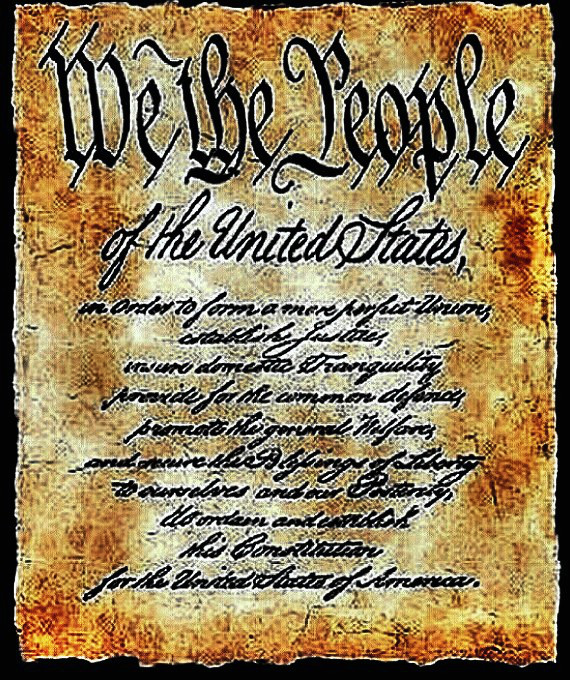
"We the People of the United States, in Order to form a more perfect Union, establish Justice, insure domestic Tranquility, provide for the common defence, promote the general Welfare, and secure the Blessings of Liberty to ourselves and our Posterity, do ordain and establish this Constitution for the United States of America."

The author of the Wikipedia article on the Preamble describes it in the following manner.

"The Preamble to the United States Constitution is a brief introductory statement of the Constitution's fundamental purposes and guiding principles. It states in general terms, and courts have referred to it as reliable evidence of, the Founding Fathers' intentions regarding the Constitution's meaning and what they hoped the Constitution would achieve. The phrase 'We the people' epitomizes the United States government's republican form."

If this is so then the first thing that needs to be recognized is the fact is that the founding fathers who gathered together were representatives of their respective independent States. Thus, we know that they were speaking on behalf of the States and not of the individual persons of their respective State as promoted by one ideology. We can know this because the union they refer to is an union of States not an union of people. The name that they chose for this new nation is proof of that.

While I might agree with the author in regards to the fact that the first phrase epitomizes the fact that the government is of a republican form, it says more than that. The word people is also a collective term. Thus, the word State may be used synonymously in its place also. So, that phrase serves two purposes. In applying this term we can use a more specific manner for the interpretation of the Constitution of the U.S. Constitution.

We can now say “We, the States,” and do so without corrupting the intent of the founding fathers. We can also refer it as saying “We the people who rule” without corrupting the meaning behind the phrase since it is the people who make up the governments of each state that are the representatives of their respective States and act in the name of their States. It also complies with the political definition of the word State which each State was at the time of the Constitution's writing. It would also recognize that each State was intended to be self ruling. By its ratification, each State was assured of remaining a self ruling State.

We can now expand that phrase to include the second phrase. Thus, we have, “We, the States, in order to form a more perfect union of States,." From this we must remember that this constitution was intended on replacing the old constitution of the Articles of Confederation. Therefore the intent to was declare that this constitution was an improvement over the last which they considered as flawed thus declaring that this was a more perfect document of rule of government.

Further expansion gives us this. “We the States, in order to form a more perfect union of States, establish justice for the States,”. We must recognize this from the fact that the founding fathers thought that the Crown was not treating the colonies in a just manner. The Declaration of Independence reveals some of the grievances that the colonies had with the Crown.

The “insure domestic tranquility” phrase would then be written as “insure domestic tranquility among the States,”. This phrase was included in hopes of averting something that seemed to be a common occurrence in Europe, wars between the States over there. That was the primary purpose of the establishment of the Supreme Court. It was set up to be the arbitrator of any domestic disputes that might lead to a war between any of the States such a the Civil war that occurred later. As set up in this manner the Supreme Court would be an unbiased independent party of any dispute brought before it.

To “provide for the common defense” phrase is pretty obvious that it was meant to be thought of in respect to the States. Its intent being to declare to all foreign nations that an attack upon one State was an attack on every State. It recognized the strength of the foreign States and the weakness of each independent State at this time and saw the value of unity for this purpose.

The rest of the preamble deals with foreign policy. It was to declare that the President was to pursue a foreign policy that was to promote the general welfare of the States, and secure the liberty for them and for their posterity in accordance to the will of the States. This was to assure that each State remained self ruled.

It is from this understanding we can see the the intent of the States who had just fought a war for the purpose of becoming self ruled and wanting to remain self ruled. To say that these States fought for independence then to turn around and subordinate themselves to another government would be inconsistent.

It is this understanding that allows us to see how the fathers remained consistent in regards to self rule under this constitution as it was declared under the previous one. It would take one hell of an argument to persuade me that this understanding was not the intent of the founding fathers as well as the States when they accepted this constitution.

Tuesday, October 19, 2010

Our Vote For a Master or Servant. Choose Accordingly

The interpretation of the U.S. Constitution is the biggest divide of this nation today. It is the foundational basis for partisan politics. When there is more than one way to interpret the Constitution at least one interpretation of it will compromise the principles of its intent for existence. This can only be called political ideology.

When the people are ruled over by those persons who adheres to this misinterpretation only one thing can be understood. It must be understood that the people are being ruled by the men of government who seek to possess absolute power and authority over the people. This is always the inevitable end result whenever political ideology trumps any and every constitution.

There are two paths that men who seek absolute power can take in order to possess the absolute power over the people they want to rule. One path would require gaining the trust of the people and the other path is by instilling fear into the people. The only difference being is that one possesses the authority as well as the power to rule in an absolute manner while the other path is the path of power without the authority to rule.

The latter path is the usual path of those we consider and identify as dictators and violence is their usual trademark to gain their power and for dissent once power is possessed. The former path uses laws not only to gain their power but also, when necessary, to stifle minority dissent. Force is the common denominator of both paths. The only difference is the intent of the use of force and whether or not force is authorized.

The path of those who seek to gain the trust of the people in order to gain absolute power will adhere to the principle that the government is the servant of the people rather than their master. They will seek to enact laws that makes it appear to be so. It is by focusing on these type of laws that results in the gaining of the trust needed for absolute power.

The path of those who seek absolute power will promote themselves as the protectors of the people rather than the enforcers of the laws they enact. In order to create this perception they must create an enemy, within a society, in the minds of the people. This enemy must be promoted as having greater power than they deserve to have. In creating this perceived enemy in the minds of the people, the people will then become dependent upon those who seek absolute rule for protection from this enemy.

In a nation that uses a democratic method of choosing their leaders one more factor must be considered. Those who seek absolute power over the people must convince enough followers to accept their political ideology as a valid basis of governing in order to be elected. This would mean that the constitution of a nation, if a nation already possesses one, must be presented and accepted as being something other than it was intended to be.

A written constitution is a document meant to recognize the need of government and to give limited powers and authority of rule to those who occupy the seats of government they were elected to as defined in that constitution. That is its sole purpose and intent of existence. If that wasn't its sole purpose and intent absolute power of government rule over the people would be the only conclusion that a person could come to.

With this limitation of power and authority as a given then it must be acknowledged When those persons enact laws outside of the powers and authority declared in that constitution they no longer are ruling over the people with authority but only ruling by the power of their position. This can only be considered as an abuse of power and a violation of their oath of office. When this occurs those who are ruled have no obligation to abide by that law thus has the constitutional authority of civil disobedience.

In conclusion, those who view government as our master will seek to have few laws enacted because they wish to rule over their own lives as much as possible. Those who view government as our servant will seek as many laws enacted as necessary to be perceived and treated as if the people ruled over their government.

So, we will be voting in a couple of weeks and we will be voting for a master or a servant. The first question a voter must ask himself before heading into that booth is whether or not he will be voting for self-rule of his own life or voting for his life being ruled over by the man he is voting for. The States have already lost their right of self rule.

Tuesday, March 23, 2010

Grandpa Makes a Fearful Prediction in Hopes He may Be Wrong. Is He Wrong?

tAs we sat there stuffing ourselves with all of the food in the picnic basket that grandma had prepared we could hear how grandpa’s words had stirred the crowd as they gathered in small groups.  It seemed as if the reaction to the words were positive but grandpa just shook his head sadly as he said,

“Words of praise are nice to hear but we have come to a point in our history where I do not believe words of protest will suffice.  It will require action from the people.  It has come to the point where we, as a nation, must be willing to show that our words mean something and that the people need to back up those words with action.

I’m afraid that we, as a people, may have gone past the point where freedom and liberty is important to the people.  Security and dependency has replaced those values in the hearts and minds of the people today.  All one has to do is look at how society reacts to the negative things that occur in their everyday life to see that.

We have become a people that no longer accepts the risks of everyday living as we once had to.  When people are broke where do they run to except to the federal government and beg for welfare money?  When anyone loses their job where do the people run to except to the government unemployment office to apply for unemployment money?

We have become a nation that is used to the idea that if you want something that in order to get it requires that you buy insurance also.  And what is insurance except the placing of responsibility on others to do what is morally and legally your responsibility?  There hardly is a moment in your life that isn’t covered by some type of insurance.

If you are in your home you are covered by home insurance.  If, in your car, you are covered by auto insurance. If, at work, you are covered by your employer’s insurance. If you are in a place of business you are covered by the insurance that business has.  Even when you are just plain walking down  the sidewalk or crossing the street you are covered by the insurance of that city.

The big problem is that in each and every case we, the people are paying for the insurance premiums in some way or another whether it be in higher prices, higher taxes, or even in lower wages. We are gradually insuring ourselves against everything except poverty and bankruptcy and that is where the path of socialism must lead us.  And that is the path of the blind and ignorant.  But, unfortunately it is the path that people, at times, must travel in order to see and understand their foolishness and wake up to the reality of life.

Now, I’ll grant that we haven’t gone down that path far enough yet that we cannot turn around and take the path of liberty once more but we are getting close to that point of no return.  The people will need to make a choice between the illusion of security or the reality of freedom.

I hope that I am wrong but I don’t think that the people have in their hearts to take back what was bequeathed them by those who gave their lives that we may know what liberty truly is. The feeling of security is a mighty strong drug and I believe that the people have become addicted to it.  And  the only leaders I see now days are those leaders that will take this nation down the path of socialism that promises even greater security.  And this is a promise that can never be kept.

Now this belief does not mean I have given up the fight for your liberty, boy.  There is too much at stake in this fight for liberty. I also know that there is much to do before that time comes when we will only have that choice of giving up or actually commit ourselves to be civilly disobedient to the dictates of those who rule over us.  I am also a practical man and the time to start preparing for the possibility of defeat is now. ”

With those words said grandpa got up and said that it was time to go home and start making preparations.  I knew there was going to be much to discuss at the dinner table for the next few days.

Followers

Words of Wisdom of my visitors

↑ Grab This Widget

Gas Buddy

Search for gas prices by US Zip Code


Design by Amanda @ Blogger Buster